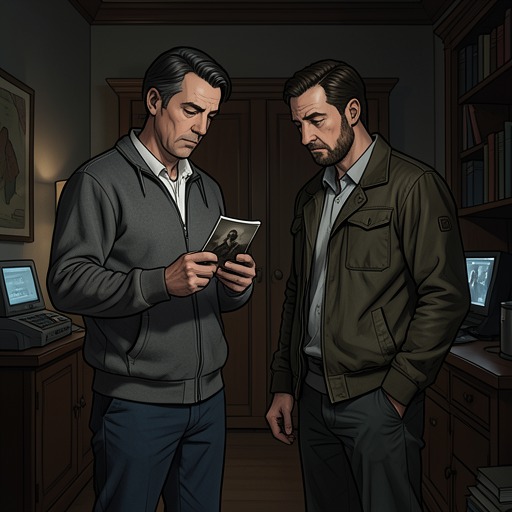
Ken Reunites with His Family
Gone for GoodKen Reunites with His Family is the long-awaited meeting of Ken Klein with Will Klein, Melissa Klein, and their father after eleven years of separation. Carefully arranged at the former Camp Millstone, the reunion converts cautious online contact into physical presence: Ken arrives, Will runs to him, and the family closes the distance through embraces and laughter. The scene offers reunion not as a clean erasure of the years apart, but as an emotional return made possible by patience, secrecy, and a place that binds childhood memory to the present.
Separation and the need for closure
The reunion follows a prolonged period in which Will remained with his father and Melissa while Ken lived apart from them. Will had spent the last eleven years with his mother, and he missed Ken intensely; he believed Ken might have missed the family even more. Ken, though still cautious, also wanted the separation to end. Their contact had developed through an online board devoted to Blue Oyster Cult, the band behind Ken’s favorite song, “Don't Fear the Reaper.” The brothers found a small number of people using the board, arranged times to exchange instant messages, and eventually used that channel to prepare for meeting again.
The wish for closure sits against a family history in which tragedy had made ordinary spaces difficult to leave behind. After Julie Miller’s body was found, Sunny’s usual volatility gave way to a subdued, passionless manner. Will’s father, by contrast, refused to leave the family house even after its windows were shot out with a BB gun. To him, moving would have meant surrender, an admission of his son’s guilt, and betrayal. The house became one example of the family’s difficulty separating memory from the place where it had taken hold.
That attachment to painful spaces appears in Katy Miller’s account of her own home. The basement remained unchanged, with its old couch, television, worn carpet, and trunk; the family still had to pass through it to reach the laundry room. Katy described the household as moving carefully upstairs, afraid of falling back into the past. When she asked her mother why she had stayed afloat after tragedy, her mother compared grief to being dropped into a stormy sea: survival, and the need to raise another child, had kept her going. These are not the circumstances of Ken’s arrival, but they illuminate the burden of family history that makes this meeting more than a simple visit. It is a step toward ending a separation without pretending that loss has vanished.
Choosing the reunion place
The location joined the brothers’ shared past to the practical demands of a private meeting. When Will was twelve and Ken fourteen, they attended Camp Millstone in Marshfield, Massachusetts. Its cabins bore college names: Ken stayed in Yale and Will in Duke. They remembered basketball and softball, blue-gray color wars, unappealing meals, and the camp drink nicknamed bug juice. Their counselors could be both entertaining and cruel. Despite the rough food and the reservations Will later had about sending a child to sleep-away camp, the brothers had loved their time there.
Four years before the reunion, Will had taken Squares to see the camp. It was in foreclosure, so Squares bought the property and transformed it into an upscale yoga retreat. He built a farmhouse on what had been the soccer field. The site had only one route in or out, and the farmhouse stood in the middle of the field, giving a clear view of anyone approaching. Its seclusion served the family’s need for caution; its history gave the gathering a personal meaning that a merely convenient safe location would not have carried.
The family’s preparations were deliberately restricted. Melissa flew from Seattle but landed in Philadelphia because they were especially wary about the arrangements. Will, Melissa, and their father met at the Vince Lombardi Rest Stop on the New Jersey Turnpike and drove to the retreat together, with Will driving and his father beside him. Nora, Katy, and Squares knew about the reunion and were traveling separately, but they would not join until the following day. The first evening was reserved for the immediate family. Even with a plan in place, the drive was quiet, and Will would not trust the reunion as real until he saw Ken, embraced him, and heard him speak.
Ken arrives
Five minutes after Will’s father wondered why the nightmare did not feel close to ending, a car approached. The family gathered at the window. Will pulled back the curtain and saw a gray Honda Accord, an inconspicuous choice, come to a stop at dusk. He wanted to rush outside but stayed at the window as several seconds passed. The delay held the family between expectation and confirmation: the car had arrived, but Ken had not yet appeared.
Then the driver’s door opened and Ken stepped out. His familiar, confident smile was enough for Will to recognize him and give way to joy. Will ran for the door; Ken was already sprinting toward the house. He burst inside and tackled his brother, and the two rolled across the carpet laughing. Will’s response recalled the ease of childhood: the eleven years between them seemed to fall away in the first rush of their reunion.
The embrace expanded into a family scene. Their father joined them, then Melissa. Will remembered it in blurred snapshots: Ken hugging their father; their father holding Ken around the neck, kissing the top of his head with his eyes closed as tears ran down his cheeks; and Ken lifting Melissa into the air as she cried and patted him, as if checking that he was truly there. The reunion’s emotional force is carried by these distinct gestures. Their father’s tears give visible form to years of separation; Melissa’s touch registers the need to verify what joy has not yet made easy to believe.
What the reunion restores
After the first rush, the family eventually calmed enough to sit on a couch. Ken kept Will close and repeatedly put him in a headlock, giving him the affectionate childhood teasing called “nuggies.” The roughhousing did not undo the history that had divided them; instead, it made their renewed closeness tangible in a familiar brotherly ritual. For Will, even being struck lightly on the head could feel good when it came from Ken.
The reunion therefore combines return with the recognition of time lost. Its setting recalls the brothers as boys, while the family’s cautious journey and Will’s refusal to believe until Ken appeared preserve the strain of their adult separation. The night begins as a meeting reserved for the immediate family, not yet the larger gathering planned for the following day. Its decisive change is intimate: Ken is no longer only a voice reached through scheduled online messages or the absent brother Will has missed for eleven years. He is present in the room, embraced by his family, and again participating in the gestures through which their bonds were first made.